AI automation for business processes, with people in control
A large part of office work is moving information from one place to another: reading a vendor bill, copying an order from a message, reminding a customer, routing a request. We automate these steps inside Odoo and add AI only where it makes the result better.
AI automation for business combines two things: rule-based automation for predictable steps, and AI models for tasks that involve reading, classifying or drafting unstructured content. In Odoo, automation rules, server actions and scheduled actions handle the first; AI services connected through integrations can extract data from documents, classify incoming messages or suggest replies. Results that affect money, customers or employees stay subject to human review, and outcomes depend on your data and processes.
 Python
 FastAPI
 Odoo
 WhatsApp
 Meta
Automation before AI
Many requests for AI are solved more reliably by plain automation. If a rule can be written, such as sending a payment reminder five days after the due date, assigning a lead by region or creating a purchase request when stock falls below a minimum, it should be an Odoo automation rule. Rules are predictable, auditable and cost nothing per run.
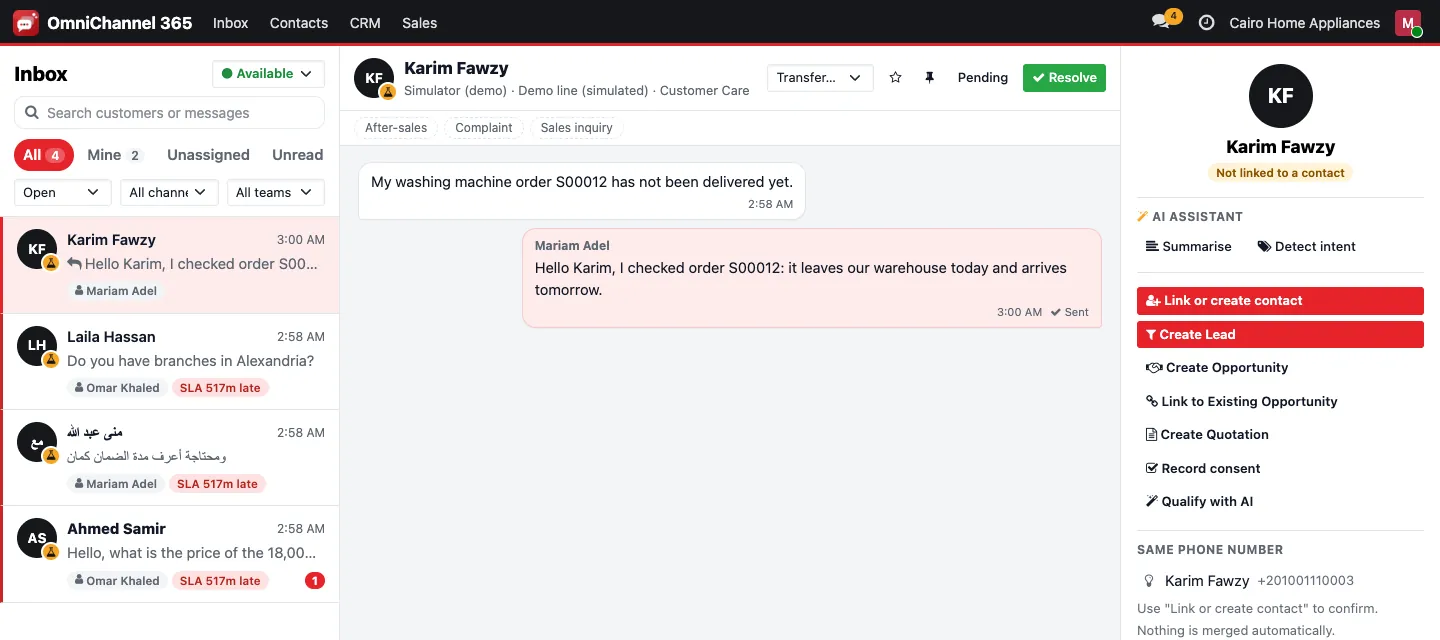
AI earns its place where input is unstructured or variable: scanned invoices in different layouts, free-text WhatsApp messages, long email threads or support tickets that need summarizing. Even then, it works best as a step that prepares a draft for a person to confirm.
Practical use cases
Each use case is scoped with its own data, review step and success measure.
Vendor bill and document capture
Extract supplier, dates, amounts and lines into draft bills for an accountant to validate.
Message triage
Classify incoming WhatsApp and email messages as order, complaint or inquiry and route them to the right team.
Lead qualification support
Summarize inquiries and suggest priority so salespeople start with the most relevant leads.
Helpdesk summaries and replies
Summarize long tickets and draft replies from your knowledge base for agents to edit.
Rule-based process automation
Reminders, assignments, approvals and record creation through Odoo automation and scheduled actions.
Internal knowledge search
Answer staff questions from approved policies and procedures, with links to the source document.
How we deliver an automation project
We start small, measure, then extend.
Pick one process
Choose a repetitive, high-volume task with a clear owner and a measurable baseline.
Design the flow
Separate rule-based steps from AI steps and define where a person reviews or approves.
Pilot on real data
Run on a sample of real documents or messages and compare results with manual handling.
Go live with logging
Every automated action is logged in Odoo so it can be traced and reversed.
Review and extend
Review accuracy and exceptions regularly, then apply the pattern to the next process.
Guardrails we build into every AI step
AI output is a suggestion until a rule or a person accepts it.
- Human approval for financial postings and customer commitments
- Confidence thresholds that send uncertain cases to a person
- Logs of inputs, outputs and who approved
- Data minimization: send only the fields the task needs
- Review of the AI provider's data handling terms
- A manual fallback when the service is unavailable
- Periodic accuracy review on sampled cases
Frequently asked questions
Will AI replace our accountants or sales staff?
That is not the goal of our projects. AI removes data entry and first-pass reading so staff spend more time on review, customers and exceptions. Decisions on money, pricing and people remain with your team.
Does Odoo have built-in AI features?
Recent Odoo versions include AI-assisted features, some of them in Enterprise only, such as document digitization and text generation, and they evolve with each release. We check what your version and edition provide before building anything custom.
Is our data safe when using AI services?
It depends on the provider and configuration. We review the provider's data retention and training terms, send only the minimum data required, and keep sensitive records such as payroll out of AI flows unless there is a clear, approved reason.
How do we know if an automation is worth it?
We measure the current effort and error rate for the chosen process before the pilot, then compare after it. If the pilot does not show a clear benefit on your own data, we recommend not scaling it.
Have a process that eats hours every week?
Request a needs-analysis session. We will assess whether rules, AI or both fit the process, and design a pilot with human review.